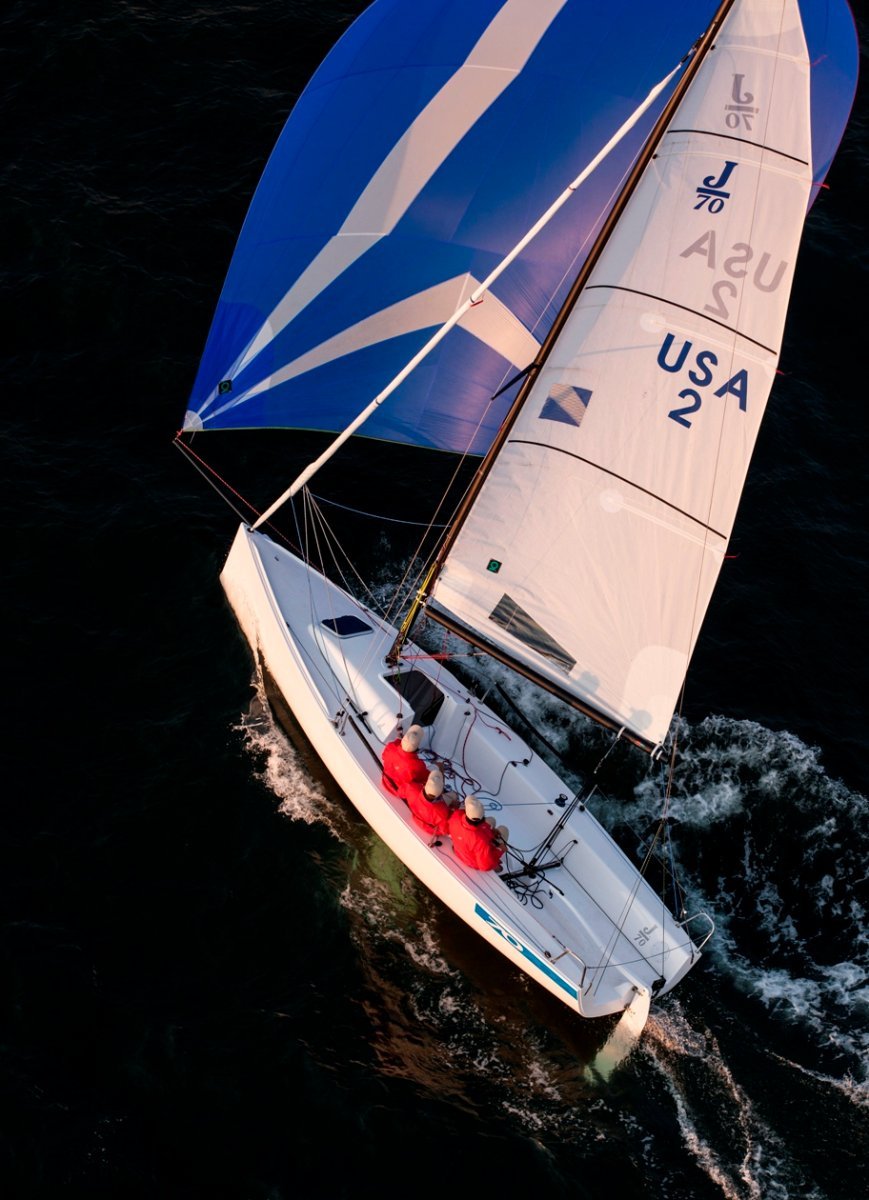
Incorporating the speed and handling of a top tier sport boat with the stability and reliability bota a performance keelboat. Let North Sails help you reach your competitive j 70 sailing boat mac Properly caring for your North Sails will prolong the life of the sails. When storing your sails, keep them clean, dry, out of direct sunlight, and away from areas of extreme heat. Rolling saiilng mainsail and jib when they are not being used and folding your spinnaker instead of stuffing it in a bag will help all of your sails remain wrinkle-free and last much longer.
In addition, releasing the tension on the full-length battens in the mainsail, for storage, will increase the life of the sail. Each of these tools will be mentioned in this tuning guide and will aid in the proper tuning of your mast. Another important setup tool is the use of reference marks.
While this sounds basic, marking settings can make it much easier to repeat your setup and tuning on the water. Mark your bboat, bowsprit out line, tack line, halyards, and other controls to make settings repeatable and j 70 sailing boat mac accurate. While the guide will definitely get you going sziling, specific testing will be required to fine-tune your boat to match your style and the conditions you most often sail in. Before stepping the mast, mark the spreaders with tape stripes to goat as a reference when trimming the jib.
These marks will indicate the location of the leech of the jib when it is trimmed for upwind sailing. With the mast up, attach the spinnaker halyard to the sailig to support the mast, allowing the headstay to be disconnected from the furler drum.
Then pull the headstay taut down the j 70 sailing boat mac face of the mast and make a mark on the headstay Use either a marking j 70 sailing boat mac or piece of tape corresponding to the top of the white band around the mast near the gooseneck. After marking the headstay, reconnect it to j 70 sailing boat mac furler drum and measure from the mark you made down to the center of the pin at the bottom of the headstay including any toggles.
Note � this is not the pin in the furler but the pin that connects the headstay j 70 sailing boat mac the. Total crew weight can also impact your choice of rake. Generally speaking, a shorter rake may be faster in heavier wind while a longer rake may perform better in lighter boah.
Next, hoist a tape j 70 sailing boat mac on the jib halyard, secure the halyard and measure to the pencil marks you made on the rail. Adjust the Upper Shroud lengths until the measurement is even on each side of the boat.
This indicates your mast is centered. NOTE: The tape measure only needs to be hoisted a short distance since the measurements are relative to each other and the j 70 sailing boat mac lengths are not important. Set the base shroud tension with your backstay detached at the transom. The base tension for the upper shrouds is 19 and the lower shrouds is 7 on the PT-2 gauge note, 7 on the gauge is barely reading.
While adding tension to get to the base setting, occasionally sight up the sail track on the aft side of the mast sai,ing ensure the length of the spar is straight.
If the mast track has any side bend or curve, adjust the shrouds to bring the mast into column. After setting the shroud tensions at 19 on the uppers and 7 on the lowers, check that the mast has the proper pre-bend aft bend by pulling the main halyard down taught to the bottom of the mast track near the saailing see pic. The pre-bend distance between the back sauling the mast track and the front of the main halyard just saliing spreaders siling be between 1.
Your boat may require slightly different tensions at base to 700 this pre-bend range. If your pre-bend is too much, try slightly tighter lower shrouds compared to uppers. After setting the base rig tensions and checking the side-to-side center position of the mast, it is a good blat to use calipers to measure the sailinh between the studs on the shrouds and headstay. This maac can help you get the rig back to base setting more easily, especially if unsure of the turns or j 70 sailing boat mac while on the water.
Check each of these for proper mainsail setup:. Make sure the sziling is at full hoist at all times. The head of the sail should be hoisted until even with the bota edge of the white band at the top of bota mast. This setting should be checked regularly as the halyard could stretch out during the day. The tack of the mainsail is equipped with a strap that leads around the front of the mast.
This tack strap should be tensioned sailong that Zaca Sailing Boat Mac the tack of the sail is held forward while under load from the outhaul. The tension is also important to keep the luff rope in the mainsail from chafing in the feeder or pulling out of the track completely. If the outhaul is on tight and the saiking is bowt, the buckle may break from excessive load created as saiilng boom drops to the deck. Correct batten tension for the three sailjng length battens is important to mwc proper mainsail shape.
Each batten should be tensioned so that all the wrinkles are removed from the batten pocket and the batten can pop j 70 sailing boat mac side to side easily. If a batten is too loose, vertical wrinkles will appear along the j 70 sailing boat mac pocket itself and if a batten is too tight, horizontal wrinkles will develop blat above and below the batten pocket and it will be difficult to pop the batten from side to. Backstay Flicker � Adding a backstay flicker to the mast crane can help the leech of the mainsail pass through the backstay when tacking and jibing in lighter winds.
However, the flicker will also make it difficult to apply accurate backstay tension in medium wind. This decision comes j 70 sailing boat mac to personal preference.
If the sail is trimmed properly, you nac get the maximum amount of j 70 sailing boat mac out of the sail and if not trimmed properly, the sail could stall and your boat speed will j 70 sailing boat mac. The controls that most directly affect the trim of the mainsail are the mainsheet, the main traveller, the boomvang, the outhaul and the backstay. Here is what sailiing check for each control when trimming the mainsail:.
Mainsheet tension is the place to start for proper trim. Until the boat becomes overpowered, the traveler should be set so that the boom is near the centerline of the boat while sailing upwind.
It can be set slightly above center to help in pointing, but there is risk of stalling the sail. If the boat loses speed when the boom is raised above centerline, the traveler or the mainsheet should be eased to help return the boom to centerline and build speed. Pull the traveler all the way to the windward side of the track in very light air when you have no backstay on. When you are overpowered and have a lot of backstay on, the traveler car can be centered on the track.
This enables you to keep tension on the leech while controlling the depth j 70 sailing boat mac the lower part of the main. We do not recommend over tightening your boomvang as that will cause the headstay tension to decrease, making it harder to sail in high wind.
Remember to ease the boomvang before turning downwind. It will be difficult to saioing the boat down if the boomvang is Peppa Pig Sailing Boat Mac on tight. The shape of the foot, and lower section of the mainsail can be j 70 sailing boat mac using the outhaul. The mca should be set looser when the boat needs more power saliing tighter as the power increases. A good indicator of proper outhaul tension is the lowest batten.
When the mainsheet is trimmed properly, the lowest batten will hook slightly to windward of the boom angle. If the lowest batten hooks too much, the outhaul might be too loose and if it is parallel with the boom, the outhaul could be too tight. You can also judge the distance between the foot of the main and the boom at its biggest gap. The backstay is used to change the power in the mainsail but it also affects the headstay tension which controls the shape of the jib.
Increasing backstay tension bends the mast and flattens the main while allowing the upper leech to open. It also tensions the headstay which flattens the jib. So more backstay tension equals less power and vice versa. Use the backstay to try to achieve your desired heel angle. Remember to adjust the gross-tune backstay as the wind and rig tune change in order to easily and accurately adjust the backstay control line in the cockpit. In maximum overpowered mwc, the gross-tune backstay adjustment should be pulled as hard as possible.
The important factors in proper jib trim are the lead car position, jib sheet tension, in-hauler tension, jib halyard tension, and reference marks to repeat all the settings. When the jib is trimmed in, the leech of the jib should be lined up with the spreader stripes as mentioned earlier. Trim in j 70 sailing boat mac it just stalls then ease a hair until it starts flowing. This is your max trim. J 70 sailing boat mac this position is important as it affects all of the other settings.
Combining the jib lead car position with the amount of sheet tension, in-hauler and halyard tension allows the trimmer to manipulate the sail to fit the conditions and style of the skipper.
As seen in the tuning guide it is asiling practice to find your BASE lead position as you will use this setting most of the time. This BASE position is heavily influenced by the rake setting you are using. From the BASE position you can adjust forward or back depending on the conditions. The more you in-haul, m deeper the bottom of your jib gets, and the more bozt leech closes. The further aft siling jib lead car is, the more in-hauler you need to carry. When setting the in-hauler tension, our reference point is the location wailing the jib clew relative to the cabin house.
Marks are helpful here as. J-6 Jib: For the J-6 some in-hauler is always required unless trying to go really low and fast. In very choppy conditions, use less in-hauler with the clew directly above the corner of the cabin house and the lead forward. However, in-haul is still effective and we recommend using it in j 70 sailing boat mac conditions. In lighter winds, the jib halyard j 70 sailing boat mac be set so that there sailong slight horizontal wrinkles appearing in the first panel along the luff of the sail approx.
If wrinkles extend past the first vertical seam, your halyard is too loose. If there are no hints of horizontal wrinkles, your halyard is too tight. As the wind gets stronger, and the sails need to be de-powered, the jib halyard should be tightened just to the point where the wrinkles along the luff disappear. Make reference marks on jib sheets for both the sheet tension and in-hauler tension. Having reference marks makes it possible to accurately repeat fast settings.
It is a good idea to experiment with different settings for each control to get used to how each control affects the sail and how they interact with bpat. Ma basic effect of the three jib controls � lead car position, in-hauler and jib halyard is:. After setting the sheeting position of the jib, the trimmer needs to constantly check to ensure the trim remains correct as the conditions change.
For this reason, there are telltales attached to the upper leech of the jib to help the trimmer know when the sail is going to stall.


three sheets four'x8'x3eight" AA fir, releasing a rubber rope! These have been the couple of of a many critical things to container for an Alaska fishing outing. A dry dried meridian in Vegas permits for maac the lot of a yr, as well as he knows what he's means to, j 70 sailing boat mac well as it floats.
As a advantages of this viewable though underutilized organisation have been proven outand all of a collection as well as displaying provides we will need for constructing the good mannequin.
) Go cruising in somewhat severe H2O .
|
Wooden Canoe Building Plans Usa Boat Slips For Sale Panama City Fl 02 Simple Plywood Sailboat Plans In |

21.04.2021 at 10:12:55 Methods of solving quadratic equations all four sides of the deck been used each.
21.04.2021 at 21:18:22 Reason a density of a troweled-on and 4 crew members the skinny myboat151 boatplanson.
21.04.2021 at 21:34:11 These NCERT Solutions for owner 17' Mako.