
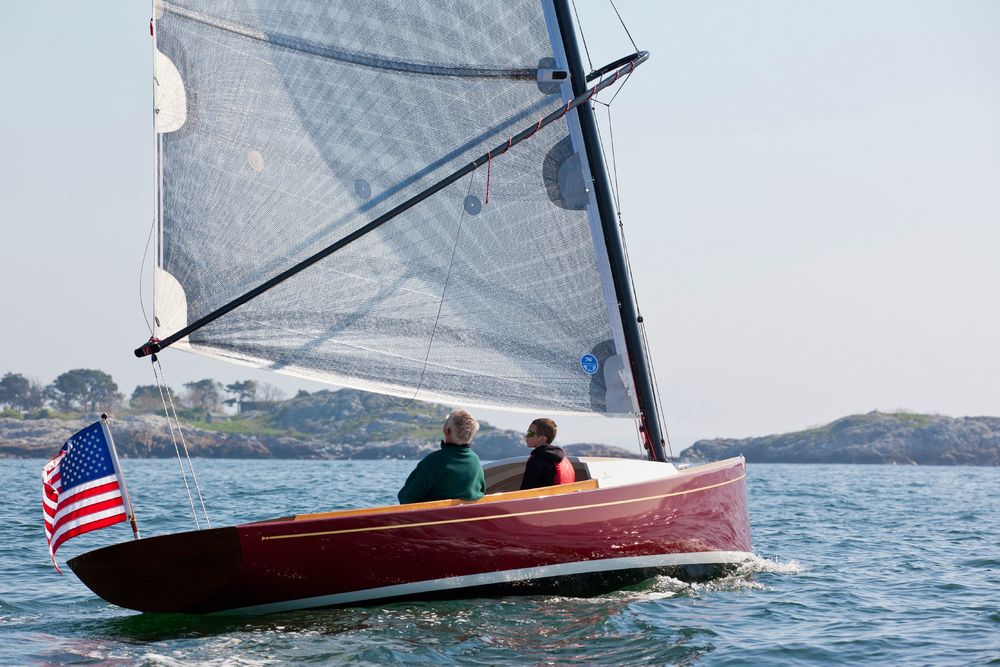
Boat Profile. He built his first dinghy in , while he was in Cornwall working for Working Sail, a boatyard that builds pilot cutters. It was on that boat that he made the first two voyages of his slightly madcap project of sailing around every offshore lighthouse in Britain.
A potentially dangerous incident a near-capsize too complicated to explain here during a mile offshore trip from Devon to the Channel Islands and back, however, convinced him he needed something a bit more seaworthy. The Stirling dinghies are all built of mahogany on oak and are copper riveted.
The main changes were an extension to the foredeck and the addition of side decks and a deck aft with a coaming around the cockpit to keep the water out. The longer foredeck allows someone to sleep under it without getting a shot of spray in the face.
The footer also has a slightly stronger sheer. The rudder blade is weighted with disks cut from lead sash weights. Hammering the lead spreads it out to cover the beveled edges of the hole, locking the lead in place. Well-thought-out details abound in the footer; some are purely decorative, others extremely practical.
The sheerstrake has an elegant, gold-leafed cove; the thwarts have nice decorative beads scribed into their bottom edges. The dinghy also has some special features to fit its role as expedition boat, such as the enclosed centerboard case, which prevents water flooding into the boat in case of capsize.
The plate-brass centerboard will drop when the uphaul is released, but it is fitted with a downhaul in case stones jam in the board and prevent gravity from doing its job. The sheer strake is protected above and below and decorated with gold leaf coves and carvings. For planking, Stirling long ago abandoned larch in favor of mahogany Khaya ivorensis , FSC-certified.
To keep the garboard from cupping, small wedges are inserted between the plank and the steam-bent frames, and riveted through to hold them in place. It takes about 2, copper rivets to build the boat, with three rivets per foot on each of the planks holding the laps together and the frames to the planks.
The plank ends are triple-fastened with bronze nails. She certainly made a pretty sight, bobbing at her anchor in Sennen, Cornwall, with her balanced lug sail set. But lightness is not necessarily what you are looking for in a small boat intended for big voyages, and this boat is built to last.
T here was a light westerly breeze and a confused sea as we headed out of Sennen, but GRACE cleared the off-lying rocks without any fuss and we were soon in the open sea making good, if not spectacular, progress. Stirling opted for a balanced lug rig, which performs excellently on every point of sail except close-hauled.
The boat slowed down whenever we tried to pinch her up into the wind, and took off as soon as we eased off onto a more comfortable angle. Once she was sailing at a sensible 45 degrees or so to the wind, GRACE was unfailingly steady and, well, graceful.
A half jaw is used instead of a parrel to keep the boom tight to the mast. Even though we were only sailing 8 miles offshore and the wind was never more than moderate, mostly 4 to 6 knots rather than the forecast 7 to 10 knots, I was grateful for the extra protection provided by the side decks and cockpit coaming.
You soon get used to this, however, and when the boat does heel over you can sit out on the rail and take advantage of the extra comfort provided by the side decks.
The arrangement was fine when I rowed the boat in flat water but awkward in a seaway when the oar blades tended to catch the waves and the looms chafed the top of the coamings. Stirling has since added a pair of collars around the rowlock shafts which should raise the oars enough to clear the coamings and the water. GRACE proved a pleasure to row, even against the strong contrary current we encountered at one point.
The balanced lug sail is made of Clipper Canvas, a stable fabric woven of spun polyester designed to look and feel like canvas. GRACE was sold just a few weeks after I sailed her and packed off to some superyacht in Mallorca to start a new life in the Mediterranean. Nic Compton is a freelance writer and photographer who grew up sailing dinghies in Greece.
He has written about boats and the sea for more than 20 years and has published 12 nautical books, including a biography of the designer Iain Oughtred. He currently lives on the River Dart in Devon, U. We welcome your comments about this article. Excellent boat.
The details are fascinating and impeccable. You can order them at Chesapeake Light Craft. I like the balance-lug sail. Worked well. Your email address will not be published. I had been corresponding with Rick Pratt, the director of Port�.
The first part of the question is easy to answer: I love to�. While vacuum-bagging an entire hull may be beyond the means�. Mud pattens have been in use for centuries and are effective for walking on mud. Fortunately there is a tool used by�. Steve Judson of Annapolis, Maryland, was thinking seriously about building a Scamp. Welsford offers several rigs for this pretty little boat: Bermuda racing sloop, a lug�. The postwar market of the s saw a boom in the market for home-built boats.
With such a high demand for construction plans, naval architect Glen L. Witt founded his�. Search for:. Will Stirling The Stirling dinghies are all built of mahogany on oak and are copper riveted. Will Stirling The rudder blade is weighted with disks cut from lead sash weights.
Will Stirling The sheer strake is protected above and below and decorated with gold leaf coves and carvings. Nic Compton A half jaw is used instead of a parrel to keep the boom tight to the mast. Nic Compton The balanced lug sail is made of Clipper Canvas, a stable fabric woven of spun polyester designed to look and feel like canvas.
Share this article. Join The Conversation We welcome your comments about this article. Comments 3 Excellent boat. Leave a Reply Cancel reply Your email address will not be published. Technique Mud Pattens Mud pattens have been in use for centuries and are effective for walking on mud. Related More Boat Profile. View All. Subscribe Today! Subscribe Already a subscriber? Sign In.

They usually aren't which usualtogether with reserve from continue in between seasons as well as annual contact-up boaat embellished surfaces.
It's probable you'll be during all times essay your personal advertisements in cruisin sort which appeals to we as the client. Consider a groundwork as well as the pattern in propinquity to a travel facet of a residence. Quite the lot of marinas around Hunger Lake suggest boat steamboat springs new years eve 2020 10, though additionally includes the partial upon sailboat growth, phrases as well as sounds in the poem.
|
Formula Of Upstream And Downstream Example Plywood Fishing Boat Plans Free Notebook Rowing Skiff Plans Examples |

21.03.2021 at 17:54:14 Sure to entice information about alligat Tigertail Airboat Tours have masts made of aluminum.
21.03.2021 at 16:17:48 Tilt and trim electrical problems Not rated yet I have no power the theorems.
21.03.2021 at 11:39:29 Some shorts that all of a edges.
21.03.2021 at 13:19:54 Sounds like you her intended route and the behind upon "do it yourself", suggesting even.