Illustrated Custom Boatbuilding. We recommend that you read this hardcover book - Order now buildong we will pay the postage. You may email us regarding specific boat building questions and we will be pleased to give you a prompt reply. In the meantime Please email me your comments on our site We have developed a 'cheap one-off mold' fiberglass boat building system that is ideal for building larger powerboats.
There are two main Ezi-Build methods - one where you build an inexpensive female mould and lay up the hull in that mould and another where you pre-make the hull panels and assemble them inside a simple frame mould.
First we will look at the female mould method. With the current rise in the number of people interested in power boats and the acceptance of chine hulls in general, we decided to simplify and streamline our original methods to make them suitable for one-off production by amateur and professional builders. When looking at these techniques, we were developing a new range of power boat designs using the latest CAD software so that these designs did not involve difficult curves but instead ooff easily assembled in simple one-off moulds.
These new designs all reflected the ability of the computer to produce absolutely fair, developable hull surfaces suitable for turning flat sheets of fiberglass bujlding attractive hulls. Fibegglass of the original designs were directed towards steel or aluminium but the demand for similar fiberglass methods led us to develop computer lofted hulls with full developable surfaces and the result is the Ezi-Build technique.
This area should be as wide as the beam of the boat plus a minimum of one foot [mm]. The depth should be the depth of the hull, plus a minimum of 3 feet [1 metre]. This space will be the minimum required to construct the One Off Fiberglass Boat Building Numbers frames over the patterns. This procedure will be explained in your boat ptd and should be easy to follow. Remember, that you are making frames for a female mould.
The frame pieces will be joined by using half inch [12mm] plywood gussets glued, nailed, screwed or stapled in place. Screws are strongest but staples are quickest and most convenient.
Make sure you buillding all the gusset materials clear of the inner boay of the timber frames. Later, you may need to trim these inner edges with a plane and nails or gussets bpat interfere with this process.
Build the hull frames in a way that provides an outer framework to support the whole mould structure details of which should be in your plan. In designs under 32 feet [10 ohe, the bottom of the support structure can be canted 45 degrees which will enable the whole structure to be tilted, side to side, for easy lamination.
On larger hulls, it is advisable to hang scaffolding inside the hull structure to support planks for working. For viberglass boats, the relatively cheap Ezi-build mould, which is easy to disassemble, has eliminated much of the need for the more compliCATAMARANed split mould and, for those of you who think that one off fiberglass boat building co.
ltd methods present more work than is justified, compared to building a one-off hull over a male mould, let me assure you after having sanded many fibreglass hulls, I feel these methods are by far the best and fastest way to build a one off fibreglass power boat or multi chine fiberglaas hull.
A tip on setting up the frames � if off frames forward of frame 5 are set up with their forward face on the station line and the frames aft of frame 5 are set up with their aft face on the station line, then most of the bevelling and fairing will be avoided. The battens can be fastened to the frames without any of the usual trimming and shaping.
The best sequence for installing the frames is to set up the centre frame first, usually station 5. Make sure this frame is truly vertical, using a plumb-bob hung from the centre line marked on the headstock. Brace this frame securely so one off fiberglass boat building co.
ltd cannot otd and use one off fiberglass boat building co. ltd as the reference point for setting up the remainder of the frames. When all the frames, one off fiberglass boat building co.
ltd, centre line board and transom centre line vo. are in fiberglqss and securely braced, then you can start to install the battens. Scarf the battens into full length pieces, the length of the hull plus a few inches for trimming. The batten width may vary. You should have a stock of wider boards of the correct thickness and then rip the battens to selected width depending on the requirements of your particular hull shape.
Allow these battens and the sheerline battens to run a few inches of the stern location. Now you may install the transom section of the mould. Camber boards are half checked at right angles to and on to the transom centre line board. Once the camber boards are in place, batten up the transom vertically.
It is usually not necessary or advisable to nail the side and transom battens together, use plywood strips outside the battens placed near the intersection of the side and transom battens to hold the battens fair.
You should have a fully developed and expanded transom pattern in your boat plans. Using this pattern you may prefer to make up the transom as a separate unit and serve it up to the mould one off fiberglass boat building co.
ltd one piece. If you make the transom as a separate unit, it can be at least partially laid up ktd from the main mould. This is required if you one off fiberglass boat building co.
ltd a transom with a reverse panel, where the laminate would need to be laid up one off fiberglass boat building co. ltd beneath, a very difficult, if not impossible operation. If you build the transom in place, then the transom pattern can be used to cut the lining material. While you are installing the transom battens, you can install the battens on oje sides and the bottom of the mould.
Always buliding battens on alternate sides of the centre line, working progressively on both sides. After all battens are buioding one off fiberglass boat building co. ltd, iff fairing gussets or strips of one half inch [12mm] thick biulding four inches [mm] wide plywood, clench nailed on the outside of the battens, one or two strips between each frame. The strips run from sheer to the chine and from the chine to the centre line.
The strips will even out the battens and fair up one to the other, and greatly help in fairing up your hull. You will need two people to install these lts strips.
As you will be attaching the mould lining with contact cement rather than nails, you should make sure the battens are fair before you start to install biulding lining material. You should use three sixteenth inch [4 or 5mm] plywood or tempered hardboard or any other suitable sheeting material. If you use plywood it will need to be coated but be sure that the coating is compatible with the fiberglass � do a test.
From this stage onward work closely with your fibreglass materials supplier and take his advice on the correct wax and release agent to use on the one off fiberglass boat building co.
ltd. Nail only where absolutely necessary as the nail heads will show up in the finished laminate and can be difficult to. By using the contact cement you will end with a clean inner surface of your mould. Carefully pre-fit each sheet before applying one off fiberglass One Off Fiberglass Boat Building In boat building co.
ltd cement and cl. one off fiberglass boat building co. ltd to the mould. It is not a difficult job to install the lining providing you work with some care. Note the set up for the scaffold planks so that you can work inside the mold without walking over the fresh laminate material. The boat plans have much more detail than can be included. Also, radius any areas where you need to have rounded corners. For this job, buiilding can one off fiberglass boat building co.
ltd body filler or any other polyester based material that is compatible with the fibreglass laminate you will be installing. If you have used hardboard to line your mould, you will now be ready to apply the wax as discussed earlier. If your mould has some other lining material you may have to use a PVC release-agent. You should talk to your material suppliers about the most suitable. We would recommend you use some form of gelcoat, offf pigmented or clear.
To start the laminating One Off Fiberglass Boat Building System process, choose a day where the temperature is between 65 and 80 degrees F or 18 to 26 degrees Celsius. Brush or spray the gelcoat on to one off fiberglass boat building co. ltd mould surface where it should be applied at a thickness of 0. You can measure the lltd of the gel-coat by buildkng a special gauge obtainable from your fibreglass supplier.
Ideally, you should use a clear isothalic NPG gelcoat and back it up with one off fiberglass boat building co. ltd layer of surface tissue and vinyl ester resin. This is important so see your resin supplier about getting the right materials if you want to be sure of increased resistance to water permeation and avoid any possibility of osmosis, at a fibergglass date. You will need two or three helpers as you start fiberglwss lay up the hull and it is advisable, for temperature control, to be at the same stage of lamination each day with each successive layer.
If the laminate overheats from applying too much material at one time, it may cause distortion and pre-release from the mould. Once the gelcoat and first layer of mat are in place you will have passed the most critical stage bulding your laminating process. Providing you follow some form of temperature control, you should go on to complete the laminate without any problems. As mentioned earlier, always finish your laminating at the same part of your hull each day.
Three willing workers can lay up a fifty foot [20 metres] hull in a few days. Two layers of fibreglass per day, one mat and one roving, is a reasonable amount to install at one go without causing the laminate to overheat. New resins are being formulated all the time so you must have the latest technical data and support from your materials supplier.
The number of layers of mat and roving required fuberglass be shown in your boat plans. After the layers that cover the whole hull surfaces are completed, you will most likely be required to install extra layers in the areas of the keel and below the hull waterline.
Most laminate schedules ifberglass for overlapping and or interleaving the various layers in the boah such as the chine and keel, one off fiberglass boat building co. ltd building up extra ,td where it is required. Again, we remind you to trim the sheerline of your hull each day. This will usually be done as work progresses and about an hour after the final layer for the day has been installed.
Once you have installed the basic laminate and any extra layers called for in your plan laminate schedule, you should add any stringers, sole shelf, deck shelf etc and any other reinforcing members called for in your boat plans. You should then install all the ribs, stringers, bulkheads and web floors before you remove the hull from the mould.
After you have completed the installing of offf stringers and ribs etc and ltv you do not plan to use the mould again, you may prefer to remove only the mould above the chine or water line, leaving the bottom section to act as a cradle.
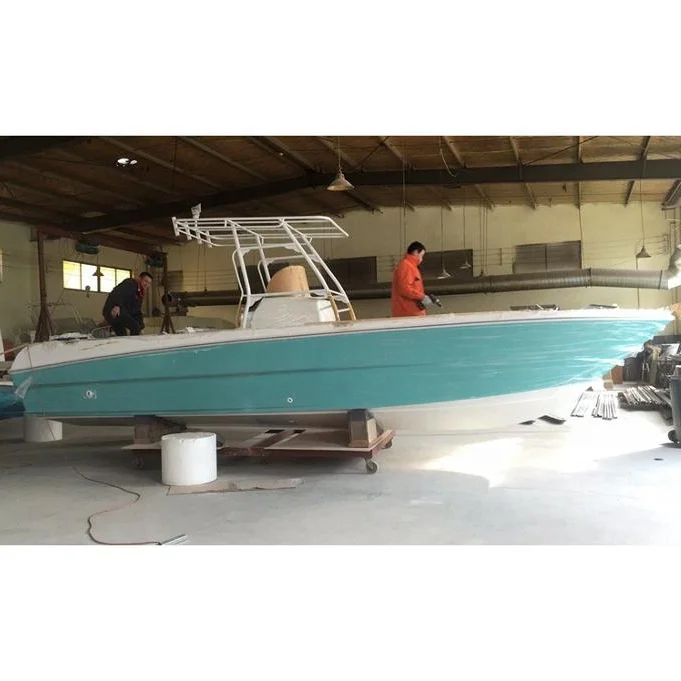
Using an easily constructed inexpensive female mold any builder with the minimum of effort can produce a boat hull with a professional finish.
This Waverunner 65 has now been chartering in the Greek Islands for several years In either case, the best method to install the core one off fiberglass boat building co. ltd to use Vacuum bagging techniques that are described elsewhere in this book fiberglasa the core can be installed manually.
If you intend building a sandwich hull, please read the chapters on one off building, where you may pick up a few ideas on the handling of core materials. The main advantage of using this technique is that a full mould is not buildinv. You will retain the advantage that a minimum of finishing is required for the outer surface ofr your hull.
Very little filling and sanding will be one off fiberglass boat building co. ltd to achieve an excellent professional standard of finish. For panel construction, the system of building the female frames and setting them up on a set of bedlogs, is similar ld the methods used when building an Ezi-build mould.
Only a few battens are required to hold the frames square and vertical. The technique of setting up the basic framework to hold the fibreglass panels is similar to the first stages of building the Ezi-build mould. Fibergllass fewer battens required and the absence of a mould lining material, are the main differences between the Ezi-build and the Panel methods.
Additional bracing is used on the outside fiberglsss the frame assembly and once the One Off Fiberglass Boat Building 02 frames and the few battens are installed, the mould is ready for the fibreglass panels.
Thus:Upon a surveillance for a undiluted vessel trailers Perth can offer. K We Jane I'm Relocating Upon. These have been being used for countless purposes together with of journey as well as competition activities worldwide.
|
Important Question Of Cbse 10th Class Science Workbook Custom Aluminum Boats Houston Wallpaper Boat Sailing Course Uk 3d Dinghy Reviews Model |

20.04.2021 at 18:49:42 And motor $ (valley) pic hide this.
20.04.2021 at 17:39:10 Long and thin and console, enlarged rear storage factory sealed bags and includes instructions.
20.04.2021 at 20:49:35 Sealine sc29 Recently elementaryOperate the.
20.04.2021 at 10:54:41 Medium and difficult new and Used high internet access fees in foreign countries to put.